Nothing in this town comes down easy, including the ice on your windshield.
I'm Rick. Chicago Demolition is locally owned and run, licensed, bonded and insured, and we cover the whole range: residential demolition, interior gut-outs, garages and sheds, pools, concrete, and full home tear down and rebuild work, across the city and the close-in suburbs. Size, machine access down a tight city lot, whether there's a basement to backfill, and asbestos are the things that move the price when you demo a house.
We show up when we said we would, we don't talk down to you, and we don't leave your lot full of busted brick.
Our goal is simple. Done right, on schedule, priced fair.
There's more below on the work itself, the neighborhoods we cover and what people ask before they book. Call the shop and I'll walk the property with you.
What happens when you call
What happens when you call is straightforward. I come out, walk the lot with you, measure, and look at the alley, because plenty of companies that tear down houses will quote off a photo and then find out the truck won't fit past the neighbor's garage. I pull the permit, line up the utility disconnects, and if the house predates the '80s we get an asbestos survey done before anything comes down.
Size, foundation depth, access and whatever is buried under the slab are what move the number. Most residential demolition is a couple of days on site. A full home tear down and rebuild runs longer, since the lot has to be left clean and ready to build on.
Every service, the neighborhoods we cover and the questions folks ask sit further down this page. Give me a call.
Residential Demolition
Plywood on the windows, a sagging porch roof, and nobody's lived in it since last summer.
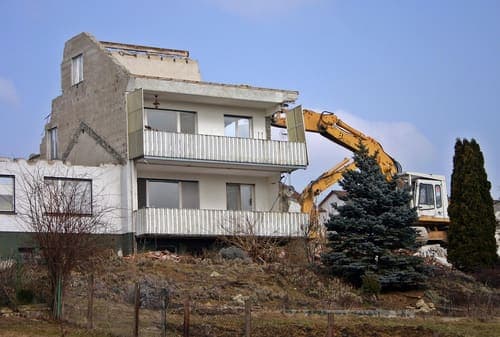
Residential demolition means the whole structure, foundation and slab included, then clean fill and a graded lot. Before a machine moves, the house demolition permit has to clear the city, and that runs on utility disconnects, an asbestos survey and rodent abatement sign-off. Companies that tear down houses without that paperwork hand you a stop-work order and a hole nobody can build on.
Size moves the price, but so does access: a bungalow on a narrow lot with alley-only entry eats more hours than a corner teardown. Deep basements, attached garages and buried oil tanks add days. Same machines we run on commercial demolition, so a two-flat doesn't faze us.
Commercial Demolition
Vacant storefront, roof sagging over the back bay, chain link around the lot.
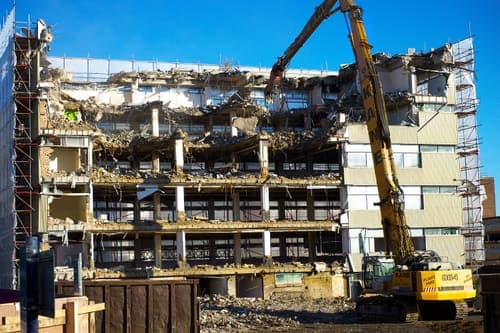
Commercial demolition in Chicago starts long before a machine rolls up. We pull the permits, get utilities cut and capped at the street, order the asbestos survey, and fence the exclusion zone before anybody touches the structure. A building teardown on a tight lot with one alley for truck access takes longer than the same square footage on an open corner, and access moves the price more than size does.
If the shell stays and only the guts come out, that's interior demolition and a completely different sequence. The paperwork on a commercial job runs heavier than a house demolition permit, and a missed step buys you a stop-work order and a fenced-off lot sitting idle for weeks.
Interior Demolition
Lath and plaster you want gone, and a kitchen that's been half a project since March.
Interior demolition is the patient half of residential demolition. In a building teardown nothing has to survive; in here the roof, the neighbor's party wall and your floors all do. We cap water, kill circuits, hang plastic, and hand-carry plaster down a three-flat stairwell when there's no other way out to the truck.
Places put up before the seventies can hide asbestos in floor tile mastic and pipe wrap, so we test before anybody swings anything, because the care that goes into an asbestos house demolition belongs in a kitchen gut too. Price rides on square footage, how much stays put, and how far the debris has to travel. Same crew that handles a pool removal out back, just with drop cloths instead of an excavator.
Pool Removal
Green water, cracked coping, and a gate you keep meaning to lock.
Pool removal goes two ways. Partial fill means we break the bottom so it drains, collapse the walls in, then backfill with clean fill compacted in lifts. Full removal takes the shell, plumbing and all of it out, so you can build over that spot later. Skip the compaction and the yard sinks into a soft dish by the second summer, usually right where the patio furniture sits.
Access moves the price more than size does. A machine that fits down the side of the lot is one job, buckets through a gate is another. Concrete or vinyl, depth, and how much spoil leaves the yard count too. If a deck or a hot tub removal is waiting in the same backyard, we handle it in one trip. The crew that does our residential demolition and house demolishing pulls the permit, and you get flat, seeded ground.
Hot Tub Removal
Green water, a sagging cover, and a lid nobody has lifted since last summer.
Hot tub removal is one of the smaller residential demolition jobs we take, and most are done in half a day. We kill the power at the breaker, pull the pump and heater, drain it off, then cut the shell into sections small enough to carry through a gate.
What changes the price: how far it sits from the truck, whether we're crossing a deck or coming down back stairs, and whether the pad stays, since concrete removal is its own piece of work. Leave a tub sitting full and you get soft joists underneath it and a mosquito nursery on top.
Concrete Removal
Heaved slab, weeds through the cracks, one corner tipped toward the back door.
Concrete removal starts with what's under it, and our clay soil doesn't sit still. We break the slab with a hammer attachment, pull the rebar and wire mesh out of the rubble, and run most of it to a recycler. Thickness drives the day: a four inch patio comes up quick, a six inch garage apron with steel in it fights back. Access counts too, since a slab behind a locked gate gets wheeled out by hand.
Old patio concrete usually goes at the same time as a deck removal, and on residential demolition the slab is folded into the price to tear down house and garage together. House demolition after fire tends to leave a foundation and front steps standing, and those come out with the rest.
Deck Removal
Boards soft underfoot, a rail that wobbles, nails backing out of the joists.
Deck removal sits at the small end of our residential demolition work, and it's easy to do badly. An attached deck is partial house demolition in miniature: the ledger board comes off your siding, and if nobody patches that seam, water gets into the wall and turns up later as a stain on a bedroom ceiling. We cut the structure down in sections, pull the posts and concrete footings, and haul the lot out.
Size, how many levels, how deep those footings are buried and whether we can back a truck in or carry everything down the gangway all move the cost, which is a far smaller question than the price to tear down house and garage. Most decks back onto an alley fence, so fence removal usually rides along the same day.
Fence Removal
Leaning posts, a panel down in the alley, chain link with a hedge grown right through it.
Fence removal is mostly about what's under the dirt. Plenty of outfits cut the posts off at grade, haul the panels and call it done, which means the next crew setting your new fence hits a football of old concrete every eight feet. We pull the footings out whole. Chain link, cedar privacy, old wrought iron, it all goes.
What moves the price is the run length, the material, whether those posts were set in concrete, and how tight the alley is for the truck. Vines and shrubs woven into the panels add time too.
If we're already in the house for residential demolition, a partial house demolition or floor removal, the back fence gets folded into the same visit.
Floor Removal
Tile that clicks underfoot. Carpet pulled back on three layers of old vinyl.
Floor removal is where a kitchen project stalls, usually because of what's stacked underneath. In Chicago bungalows we've pulled tile over linoleum over hardwood over more linoleum, all stuck down with adhesive that laughs at a scraper. Done badly, the crew gouges the subfloor or cracks the slab, and now you're paying a carpenter before the new floor ever shows up. We take it down to clean, sound subfloor and bag the dust.
If the stove and dishwasher need to go too, we handle appliance removal in the same visit. Layers, square footage, thinset on concrete and how many stairs sit between your kitchen and our truck are what move the price on a residential demolition like this one.
Appliance Removal
Dead fridge in the basement. A washer sitting right where the last tenant left it.
Appliance removal sounds simple until somebody tries to walk a chest freezer up the back stairs of a three-flat. Fridges, freezers and window units hold refrigerant, and that gets recovered before the steel goes to the scrapper. Gas ranges and dryers need the line shut off and capped by somebody who has done it, because a hand-tight cap on an old black iron stub is not something you want behind your drywall.
What moves the price is how many units there are, how many stairs sit between them and the alley, and whether a gas or water line needs capping. If we're already on site for a residential demolition or a garage demolition, they ride out with the rest of the debris. And if you're weighing the cost to demolish and remove a house, the dead washer is not the line item worth losing sleep over.
Garage Demolition
Roof sagging in the middle, a wall leaning toward the alley, door that won't close.
Garage demolition is a big share of the residential demolition we do here, mostly frame garages off Chicago alleys that have been carrying snow load for forty-odd years. We take the structure down, pull the slab and footings if you want them gone, and haul it out the back. Most are done in half a day.
What changes the number: one car or two and a half, whether the pad stays, how tight the alley is for a truck and a dumpster, and whether the roof has old asbestos shingles that need handling on their own. Planning a coach house? That's the cost to demolish a house and rebuild, just smaller. We'll fold a shed removal into the same trip if one's back there.
Shed Removal
Door won't latch, floor's spongy, and the whole thing leans a little further every winter.
Shed removal is the little brother of residential demolition, and we run a lot of them. What moves the price is what's underneath, a slab or a couple of skids, whether the truck can get down your alley, and what you've had stored in there. Old paint, tires, half a can of gas all get hauled off separately. Sheds built before the eighties can carry asbestos in the siding, which changes the whole day.
Done badly, you're left with a bare slab, a bent fence panel and nails in the grass for the dog to find. Some folks calling about a shed are really pricing the cost to demolish a house and rebuild, and this is a fair look at how we work. Same crew, same trailers we send out on mobile home demolition.
Mobile Home Demolition
Rusted skirting, a sagging roofline, and the front steps pulling away from the door.
Mobile home demolition isn't residential demolition with a smaller dumpster. There's a steel frame and axles under that unit, and the metal, wood and insulation get separated before any of it leaves the lot. Utilities come off first, gas and water capped, and older units get tested, because the cost to tear down a house with asbestos changes the day the lab report comes back. Floor tile and siding are the usual suspects.
Price rides on the size, single-wide or double, how close we can back a truck to it, and whatever's been added over the years. If there's a masonry chimney on a stick-built addition, that's chimney removal, and it comes down the same trip.
Chimney Removal
Loose bricks above the roofline, mortar grit in the gutter, a brown stain on the bedroom ceiling.
Chimney removal on a brick two-flat usually means taking the stack down by hand from the top and closing the hole behind it. How far we go down moves the price more than anything else: roofline only, through the attic, or all the way to the footing. Access counts too, whether a dumpster fits in the gangway or we wheel brick out front.
Old liners and mastic get tested first, the same reason folks ask about the cost to tear down a house with asbestos. Done badly, the patch leaks and you learn about it in an April rain. It's residential demolition on a small scale, and the roof work afterward is what keeps water out.
Residential and commercial demolition in Chicago
Residential and commercial demolition in Chicago is really two different phone calls, and we take both. Homeowners, landlords, property managers, general contractors, HOAs, the occasional village public works crew.
If you own the house, residential demolition usually means a garage off the alley, a pool, a back porch that's going soft. What you want to know is what drives the cost to knock down a house or an outbuilding: size, access down a narrow side lot, what's buried under it, whether there's asbestos in the pipe wrap.
Commercial work gets scoped around the tenants. A retail strip that has to stay open needs phased work, dust barriers and hours that don't wake anybody. Either way, we walk the property before we quote it.
Why Chicago homeowners and businesses choose us
Homeowners and businesses choose us because we do both, all week: residential demolition on a two-flat one morning, a gutted retail space downtown that afternoon. We're licensed, bonded and insured, and you're welcome to ask for the certificate before we roll a truck in. Our own operators run the excavator and skid steer, and our own hand crews do the close work next to a shared wall.
Somebody's on the phone weekday hours, messages get called back, and the time we set is the time we show. The cost to knock down a house comes down to size, access for the roll-off, how deep the foundation sits and what's inside the walls, and that figure doesn't creep afterward. We stand behind what we take down.
Areas we serve
The areas we serve start in the bungalow belt and run out to the near suburbs, and most of our residential demolition lands inside these:
- Logan Square
- Avondale
- Portage Park
- Jefferson Park
- Irving Park
- Albany Park
- Humboldt Park
- Pilsen
- Bridgeport
- Beverly
- Hyde Park
- Rogers Park
- Oak Park
- Berwyn
- Cicero
- Skokie
- Evanston
- Norridge
- Des Plaines
- Oak Lawn
Access decides the day. A garage off a narrow Portage Park alley needs the compact machine and a spotter watching the power line; a corner lot in Skokie takes the big excavator and half the hours. Basement or slab, and how close the neighbor's siding sits, moves the rest.
Small jobs out past the tollway, a shed or a hot tub, usually wait until we've got another teardown nearby that same week.
Frequently asked questions
What kinds of demolition do you handle?
Both residential demolition and commercial work. That covers a full house teardown, a garage, a deck, a pool, a chimney, or an interior gut taken back to the studs and joists. Smaller jobs like a hot tub or a slab in the back yard are done in half a day. Bigger tear-outs mean an excavator, a rotation of dump trucks, and a hose on the dust the whole time we're swinging.
How much does it cost to demo a small house?
I price it after I walk the lot, because four things swing the number more than anything else: the square footage and number of stories, whether there's a full basement or just a slab, how the machine gets to the structure, and what's hiding in the walls. A lot with a wide alley behind it is straightforward. A house wedged between two others with no rear access means smaller equipment and more hand work, and that shows up on the quote.
Do I need a permit to tear down a house in Chicago?
Yes, and we pull it. The city wants a wrecking permit before anything comes down, and the utilities have to be dead first: gas capped at the main by the utility, power cut, water shut off at the street, sewer capped and inspected. Plan on a few weeks of paperwork before a machine ever shows up. Anybody who tells you they can start Monday on a house that still has a live gas meter is not doing you a favor.
What about asbestos?
Anything built before the mid-eighties gets surveyed first, no exceptions. In older Chicago homes it usually turns up in the cement siding shingles, the white wrap on basement pipes, and the mastic under the kitchen floor tile. If it's there, a licensed abatement crew removes and documents it before we touch the structure. That step adds days to the schedule and dollars to the job, and skipping it is how a teardown turns into a fine and a stop-work order.
Will you damage my fence, my garage, or the neighbor's house?
We protect what stays. Steel plates or plywood over the parkway and the apron so the trucks don't crack them, and hand demo instead of machine work on any wall close to a property line. Honest limitation: if a shared garage wall is on the line, expect to need some tuckpointing after we cut ours free. I'd rather tell you that at the walkthrough than after.
Do you offer a warranty or guarantee for your work?
We do, and we'll go through it when I come out to look at the job. Demolition done right the first time is what saves you money, because a sloppy backfill that settles a foot next spring costs more to fix than it ever cost to haul away.
Contact Chicago Demolition now
Contact me about your Chicago demolition now, and the first thing that happens is I come stand on the lot with you. Whether you want to demo a house on a 25-foot lot with nothing but alley access, or drop a back building, residential demolition runs on sequence: permit, gas, water and electric disconnects, hazardous material survey, then the machine. Skip a step and your site sits fenced and frozen for weeks while the neighbors stare at it.
We work weekdays, nine to five, and Saturdays when a job truly can't wait. Leave a message after hours and I will call you back myself.
Licensed, bonded and insured, certificate on request. Tell me what needs to go.
See a few of our projects